01 / The reveal
This is the Jaguar people will be able to buy
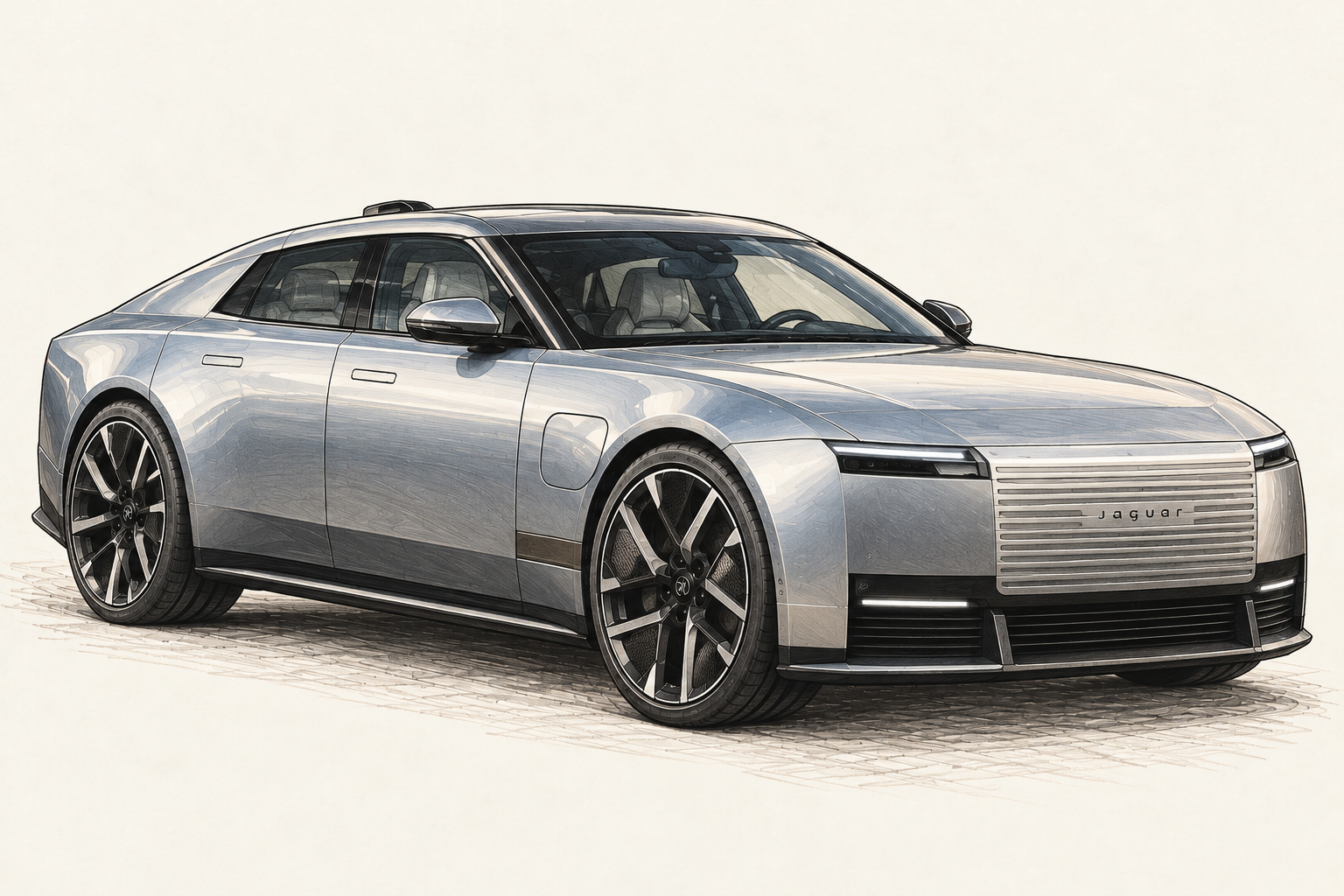
After the concept, the camouflage and the arguments, there is finally a production design to look at. Jaguar revealed the Type 01 in New York on 6 October 2026. It is an electric GT with four doors, and the first model in the brand’s new generation. Customer cars are still to come.
The distinction matters. The Type 00 was the design concept; the Type 01 is the car that takes those ideas towards customers. This article covers the launch announcement, rather than a road test. The performance and range figures are Jaguar’s claims, and some specifications remain subject to final certification.
For anyone who has followed the launch through short clips and photographs, the useful questions are now quite straightforward. How much of that unusual design has survived? What is underneath it? How much will it cost? And when does the reveal become a car someone can actually collect?
The answers describe a substantial change for Jaguar. This is a large, expensive electric grand tourer with a deliberately unusual shape. Whether you like that direction or not, it is worth looking at the car itself before making the advertising campaign the whole story.
02 / The design
The long bonnet stays
Auto Express reports a length of about 5.2 metres and a height of roughly 1.4 metres, with a wheelbase around 3.2 metres. The proportions make more sense with those dimensions in mind: this is a very large car with a low roof, rather than a compact sports coupe stretched slightly to fit another pair of doors.
The same publication explains that Jaguar developed a dedicated structure to accommodate the shape. Battery packaging leaves a space for the rear occupants’ feet, with some cells positioned ahead of the cabin. That helps explain why the design could not simply be placed over an existing platform.
Look at the side profile and the distance between the front wheels and the windscreen is hard to miss. The cabin sits well back, and the surfaces are broad and relatively clean. In our view, those proportions do more to define the car than any individual badge or lighting detail. It is a shape you are unlikely to confuse with an ordinary saloon.
The production design also keeps the glassless rear. Jaguar replaces the conventional view through a rear window with a camera display. That is a meaningful change to how the driver sees behind the car, not just a styling flourish. How naturally it works in daily use is something a launch photograph cannot settle.
03 / Power and hardware
Three motors and four driven wheels
Jaguar’s launch release specifies three motors, up to 1,030PS and 1,365Nm. The claimed acceleration is 3.2 seconds from 0 to 62mph. Jaguar also quotes 4.0 seconds from 62 to 112mph, highlighting the performance available once the car is already moving.
The car uses the new Jaguar Electric Architecture, or JEA. An 850 volt electrical system and a 118kWh usable battery form part of that package. These are the launch specifications, rather than measurements from an independent test.
The UK product page lists air suspension, active dampers, steering at both axles and torque vectoring. In simple terms, there is technology to vary suspension behaviour, help a large car turn and manage the contribution of its motors. The presence of that equipment tells us how Jaguar intends to control the car, but does not prove how well the finished result rides or handles.
It is tempting to let the power output dominate the conversation. For a grand tourer, however, the quieter details will matter just as much: smooth responses in traffic, a settled ride and controls that make a long journey easy. Those remain questions for the finished customer car, rather than conclusions to draw from the specification.
04 / Range and charging
What the range figures actually mean
Jaguar estimates up to 450 miles under WLTP and up to 400 miles under the American EPA measure. These are different test procedures, so the figures should not be treated as contradictory. Jaguar’s release says the estimates are ahead of full certification; neither is a promise of the distance every owner will achieve.
The advertised rapid charging figures are up to 350kW, with a 10 to 80 per cent charge in as little as 22 minutes. Jaguar also quotes up to 200 miles of added range in 13 minutes. Battery temperature, starting charge and the charger itself affect the result.
The distinction between peak power and a charging session is important. A car does not necessarily take its maximum advertised rate from the moment it is plugged in until the moment it leaves. For someone planning a journey, the time needed to restore a useful amount of range is more informative than the biggest number on the charger.
The sensible next step is to wait for measured charging curves and repeatable range testing. A warm day and a prepared battery are different circumstances from a cold evening after a short drive. For now, the announced figures set out Jaguar’s ambition. They do not replace a proper account of how a customer car behaves between charging stops.
05 / Inside
Four places, divided by a central spine
Jaguar previewed the cabin before showing the complete car. Its defining feature is the central spine running through the interior, dividing it into four individual seating areas. The low seating position, long horizontal lines and concealed storage are central to the design, rather than details added around a conventional dashboard.
The launch release describes a 24 inch OLED display and a separate seven inch touchscreen for frequently used functions. Brass effect finishes carry the longitudinal theme through the cabin. It is a noticeably different approach to the wood and traditional switchgear many people associate with older Jaguars.
Four doors should not be confused with an assurance of generous space for four adults. Auto Express points out that the proportions take priority over maximum cabin room, describing the seating as a 2+2 arrangement. Anyone interested in carrying passengers regularly will want to try the rear seats in person.
That is one of the more interesting tensions in this car. A grand tourer can be deliberately indulgent, but it still needs to accommodate the journey its owner has in mind. Rear access, luggage and somewhere to put everyday items deserve as much attention as the screens. We will leave those practical judgments open until there is more than a launch presentation to assess.
06 / Price and arrival
From £129,950 in the UK
Jaguar’s UK website currently lists the Type 01 1030PS from £129,950 on the road, with Design Vision from £144,950. Those are the published UK starting prices checked for this article. Earlier estimates around £120,000 should not be mistaken for the current official figure.
Orders are expected to open in early 2027, with first customer deliveries anticipated in the second half of that year. Those are Jaguar’s announced expectations, not confirmation that cars are available to collect now. Final equipment and specifications may change before launch.
JLR says the Type 01 has been designed and engineered in Britain and will be built at Solihull. For a car presented as such a major departure, that gives the launch a direct connection to the company’s existing British operations.
The reveal is therefore the start of the buying story, rather than the end. The next useful information will be the full ordering details, final certification figures, equipment by version and confirmed delivery arrangements. Anyone considering a deposit should work from those documents and the terms offered to them, rather than treating a launch headline as a complete specification.
07 / What comes next
The car can finally take centre stage
The Type 01 gives the discussion something more substantial than a concept and a slogan. We now have the production design, a detailed technical outline, official UK starting prices and an expected route to customer deliveries.
Our interest is in what happens when all of those decisions meet ordinary use. The camera view, the low cabin, the long body and the charging system are not separate talking points once someone is living with the car. They have to work together on a wet evening, a weekend away or a journey that runs longer than planned.
That is why we are keeping this as launch coverage. There is plenty to report without inventing a driving impression or awarding a score. For now, Jaguar has shown what it intends to build. The next chapter is seeing the finished Type 01 reach customers and finding out how closely the experience follows the promise.