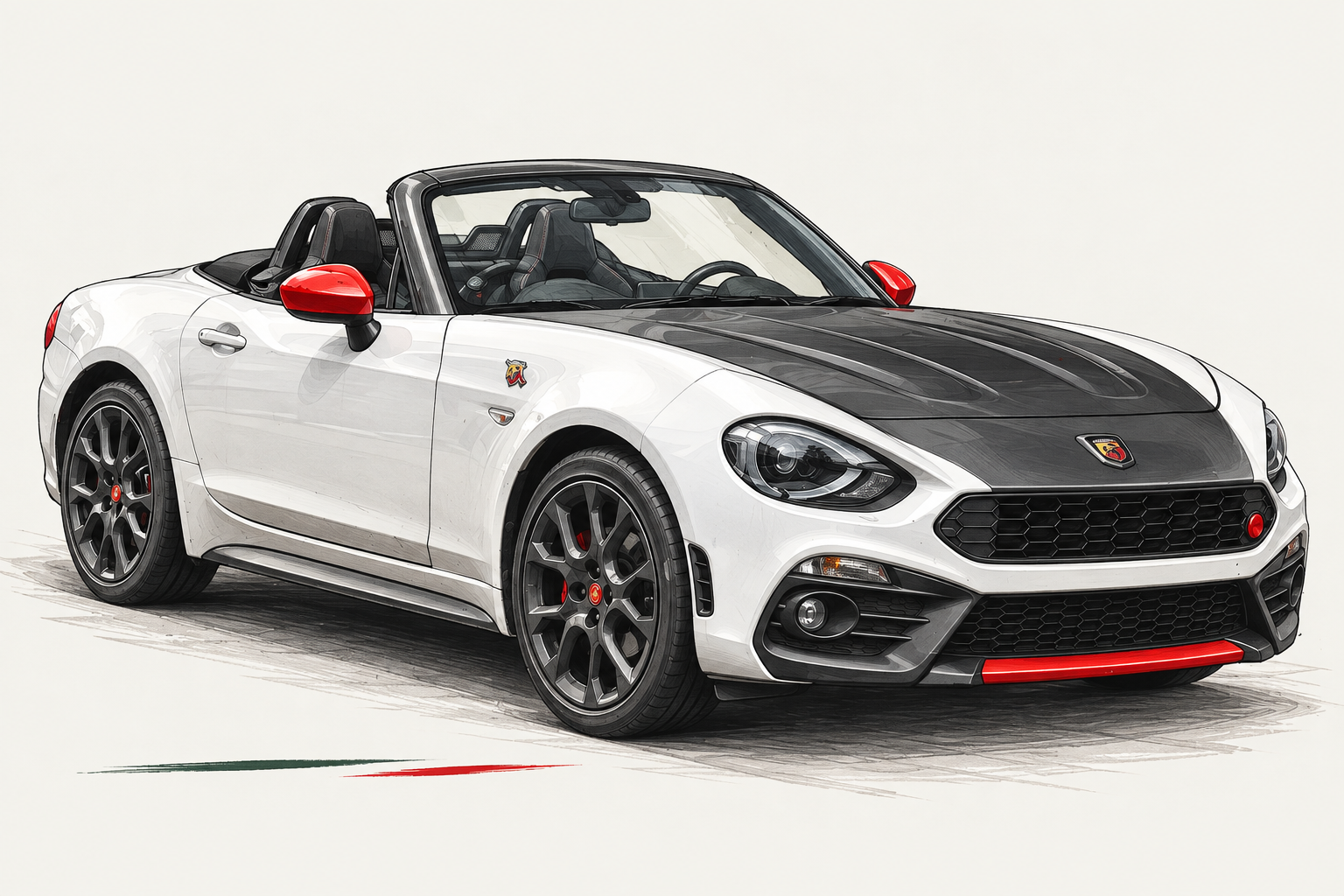
01 / ORIGINS
Italian or
Japanese?
The short answer is both. The 124 owes a lot to Mazda, but the engine, styling and Abarth changes give it a different feel.
The 124 shares its platform and much of its cabin with the ND Mazda MX5, and was built in Hiroshima. Fiat supplied the turbo engine and its own bodywork. Abarth then added its suspension setup, exhaust and other changes. So yes, there’s plenty of Mazda underneath, but this isn’t just an MX5 with different badges.
The shape takes its cues from the original 124 Spider. It has a longer bonnet and softer lines than the Mazda, with four exhaust tips and contrasting details on the Abarth. It looks distinctive without needing to be a big car.
Italian expression
The styling, Fiat’s MultiAir engine and the Record Monza exhaust give it much of its personality.
Japanese foundations
The Mazda platform gives it its small footprint, low seating position and straightforward folding roof.
Inside, the Mazda connection is obvious. The controls are familiar and easy to use, but the materials won’t impress someone coming from a more upmarket coupe. It’s a small sports car cabin, and you notice that.
02 / ENGINE & CHARACTER
The engine
makes the difference.
If you’re comparing this with an MX5, start with the engine. They go about things quite differently.
The European car’s 1.4 litre MultiAir turbo makes 170 PS and 250 Nm. That isn’t a huge amount of power these days, but there isn’t much weight to move either. You get useful acceleration in the middle of the rev range without having to work the engine hard all the time.
There’s a little wait for the turbo at low revs, followed by a stronger pull as it gets going. The naturally aspirated Mazda delivers its power more evenly. Which you prefer comes down to whether you enjoy that boost or want a more immediate response.
The Record Monza exhaust is a big part of why people want one. It sounds lively for such a small engine. Just remember that you’ll hear it on the way to work as well as on a Sunday drive. On a long motorway journey, the noise can wear thin.
You don’t need huge power to enjoy a small car with the roof down.
Abarth quoted 6.8 seconds to 62 mph for the manual. That’s quick enough for this sort of car. The low seat, open roof and exhaust do plenty to make a drive feel exciting without chasing bigger numbers.
03 / CHASSIS & FEEL
How it feels
on the road.
It sends its power to the rear wheels and has a limited slip differential. Add the low weight and you have the basics of a proper little sports car.
European cars get Bilstein suspension and Brembo front brakes. The Abarth is set up to feel sharper than the standard Fiat, but it’s still a road car. Its small size is useful on narrow lanes where a bigger performance car can feel awkward.
Period reviews generally liked the steering and manual gearchange, although opinions on comfort differed. You will feel rough surfaces. If you’re used to a quieter, heavier coupe, the ride can feel busy and a bit tiring.
Tyres and alignment make a big difference here. Check tyre age, condition and pressures before judging how a used example drives. Worn suspension or a poor setup can spoil a car that should feel precise.
ON ROUGH ROADS
You’ll feel the bumps.
That close feeling to the road is enjoyable when the surface is good. On a battered commute, you might wish it filtered a bit more out.
04 / THE EVERYDAY REALITY
Could you
use it every day?
Yes, but take it on the sort of roads you normally drive before deciding. A quick sunny test drive won’t tell you everything.
The cabin
You sit low, with the main controls close to hand. Storage is limited and some of the materials feel basic. If you’re tall, spend time getting comfortable with the roof closed. Make sure the seat and steering wheel position work for you.
The technology
The original infotainment feels old now. It handles the basics, but don’t expect the speed or phone integration of a newer car. Equipment and retrofits vary, so check what the car you’re viewing actually has.
The roof and luggage
The fabric roof folds by hand and is easy to use. With two seats and a small boot, you’ll need to pack lightly for a trip. Soft bags help. Check the roof, seals and drains, and feel the carpets for damp.
The commute
Motorway driving brings plenty of wind, tyre and exhaust noise. That’s fine for some owners, but it can become tiring over a long commute. If most of your driving is spent in traffic or on motorways, think about how often you’ll get to enjoy the car elsewhere.
Fuel and running costs
Don’t assume the small engine makes it cheap to run. Fuel use depends on your route and how you drive. Allow for insurance, decent tyres, servicing and repairs as the car gets older, as well as the petrol bill.
05 / TWO WAYS TO DRIVE IT
Three pedals,
or two?
Both gearboxes have six speeds. The manual is more involving; the automatic makes traffic easier. Try both if you can.
SIX SPEED MANUAL
The manual.
Period reviewers often picked out the gearchange as a highlight. If changing gear is part of what you enjoy about driving, this is the one to try first.
- 0 to 62 mph
- 6.8 sec
- Published weight
- 1,060 kg
- Best fit
- Weekend roads
SIX SPEED AUTOMATIC
The automatic.
It takes the effort out of traffic and gives you paddles when you want to choose the gears yourself. Reviewers disagreed on its responses, so try normal and Sport modes and see how it suits you.
- 0 to 62 mph
- 6.9 sec
- Published weight
- 1,080 kg
- Best fit
- Mixed daily use
These are European manufacturer figures. The automatic uses a conventional gearbox rather than a dual clutch setup.
06 / OWNERSHIP
What to check
before buying.
Service records and condition matter more than how good it looks in the advert.
Use the checks below as a starting point. They aren’t a list of faults every 124 will have. A specialist inspection can help you work out what a particular car needs.
01 Service history & engine
Look for invoices showing the correct oil specification and regular servicing. Confirm the timing belt requirements for the exact model with the handbook or a specialist, and establish what has actually been replaced. Start it cold and check for warning lights, leaks, persistent smoke or an uneven idle. None should be dismissed as “just character”.
02 Brakes, tyres & suspension
Check matching, suitable tyres, even wear and their age. Inspect discs and pads, and check for pulling, dragging or uneven braking on a safe test drive. Listen for suspension knocks and look for leaking dampers. Budget from an inspection report rather than guessing from mileage.
03 Roof, body & underside
Operate the roof, inspect its fabric and seals, and feel the carpets for damp. Have the underside checked for corrosion, impact damage and poor repairs. Check panel alignment and paint consistency. Attractive photographs do not show the condition of the structure underneath.
04 Exhaust, equipment & modifications
Check the exhaust condition and valve operation, every cabin control and both keys. Ask for documentation for software changes, suspension modifications and aftermarket parts. Confirm that any modifications are acceptable to your insurer before committing.
05 The right test drive
Include a rough road, traffic and a short faster road stretch. Try the roof up as well as down. Make sure the seats, noise level and gearbox suit you after the initial excitement wears off. Check outstanding recalls using the registration or VIN and official manufacturer or government services.
