01 / The idea
A name worth bringing back
There is something pleasingly straightforward about the idea of a Vanquish. Two people, enough luggage for a few days and a very large engine ahead of them. It is the sort of car that makes you think about where you could go before you start looking at the numbers.
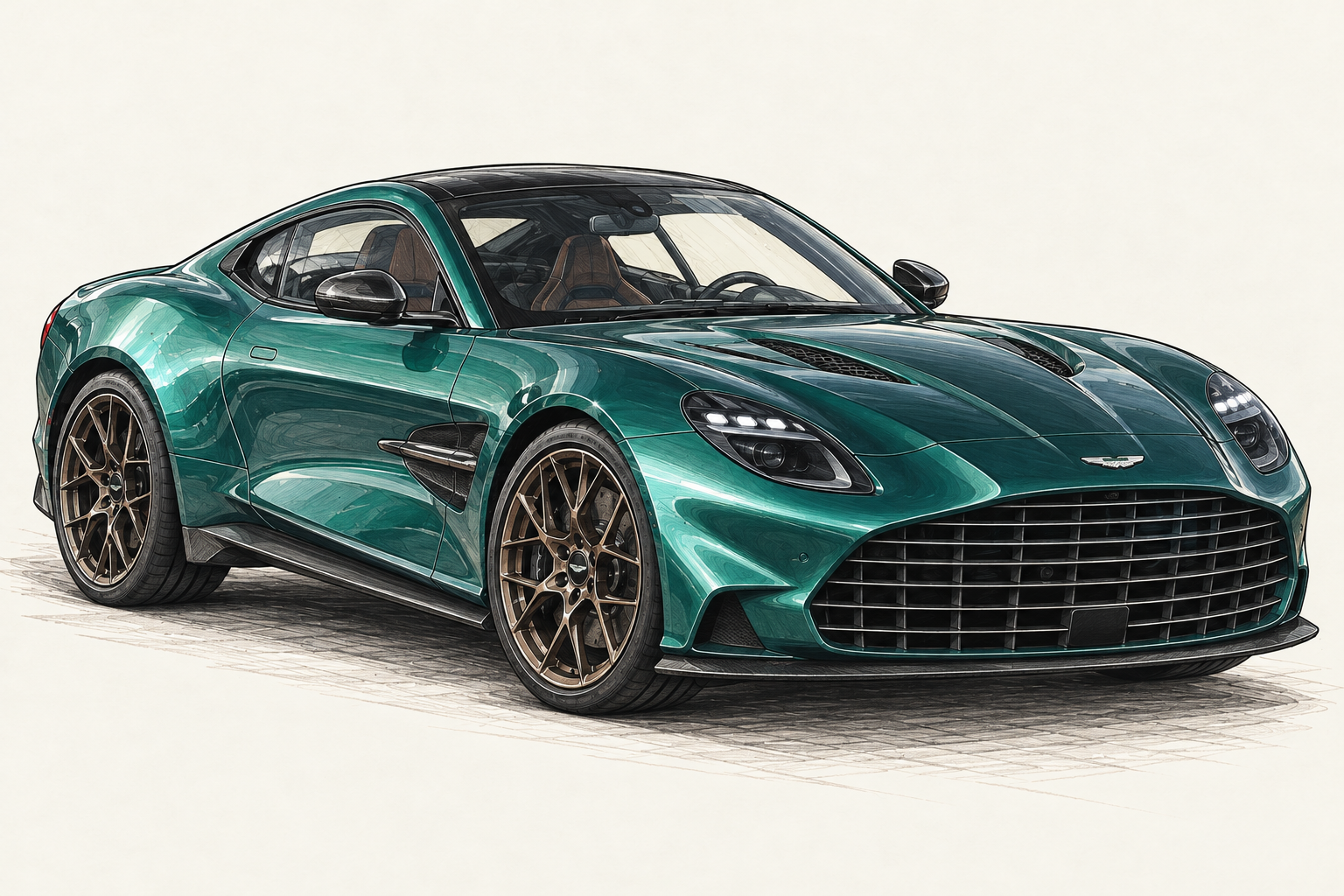
This is the third generation coupe, introduced in September 2024 and reviewed here in 2026. It takes over the flagship role from the DBS. Aston Martin stretched the wheelbase by 80mm compared with that car and wrapped a bonded aluminium structure in carbon fibre bodywork. The extra length gives the bonnet a considerable part of the conversation.
Our view of the shape is that it works best without too much decoration. Deep green paint, silver wheels and a quiet interior colour would be our starting point. The broad grille is hardly shy, but the long side profile is what makes this look like a proper grand touring Aston.
02 / Engine & gearbox
The reason you came
Aston Martin quotes 835PS, or 824bhp, and 1,000Nm from a 5.2 litre twin turbo V12. An eight speed ZF automatic sends that to the rear wheels through an electronic differential. The claimed figures are 3.3 seconds from rest to 62mph and a top speed of 214mph.
The more useful question is how it delivers all that performance. Auto Express found the engine a huge part of the appeal, with the sound and muscular delivery to give the car a character of its own. Its review also judged the Ferrari 12Cilindri’s gearbox and chassis slightly ahead. That is a useful reminder that the largest number on the page does not settle everything.
We would want the engine to feel special at ordinary speeds as well as extraordinary ones. A grand tourer spends plenty of its life following traffic, leaving villages and settling into a cruise. The attraction here is having that V12 along for the whole journey, rather than finding somewhere to use every last horsepower.
There is more engineering behind that output than a change of software. Aston’s launch material describes stronger engine internals, revised cylinder heads and lower inertia turbochargers. Its Boost Reserve system holds extra boost pressure ready during part throttle running, releasing it when the driver asks for more. The aim is a quicker response without waiting for pressure to build from scratch.
Andrew Frankel’s Motor Sport test adds a useful qualification. He noticed less pull than expected at very low revs, then enjoyed the way the engine gathered strength as its speed rose. He also felt the acceleration figure understated the car’s performance once moving, because a standing start is limited by traction. It is worth separating that observation from a promise that every press of the pedal delivers the same response.
For us, the transmission deserves attention for the quieter work too. Does it choose a sensible ratio when a gradient changes? Can you ease into a parking space smoothly? Does a gentle request for more pace produce an unnecessary downshift? Those are questions to answer on a drive, because they determine whether the V12 feels like an indulgence you enjoy every day or something you only appreciate when the road opens up.
03 / On the road
Give it some room
Evo’s road testing paints a more complicated picture than the headline performance suggests. It praises the balance and the engine’s voice, but finds the car more demanding on rough surfaces, where the steering and suspension can make you work. Narrow roads also bring its size into focus.
That matters if your favourite Sunday route is lined with stone walls. Aston lists a width of 2,120mm including the mirrors. Before worrying about which drive mode to use, consider how much road you have to play with. A test drive should include the awkward sections you know, not just a generous stretch of dual carriageway.
Auto Express found a compelling mix of luxury, pace and a slightly raw edge. Read alongside Evo’s reservations, that suggests a car whose appeal depends quite heavily on where you take it. Our ideal trip would give it space: an early start, open roads and somewhere worth stopping at the other end.
The hardware includes adaptive Bilstein DTX dampers and standard carbon ceramic brakes. Aston developed separate damper settings for GT, Sport and Sport+, with progressively tighter body control. Its electronic differential works with the stability system to manage the rear axle. These are tools for controlling a substantial car; they cannot give a wide coupe the footprint of something smaller.
Frankel found the handling assured, though he noted that a change of surface under power could move the rear of the car. He also judged the DB12 a little more eager to change direction. That comparison is especially revealing: choosing the flagship does not automatically buy you the most agile Aston. The longer car and larger engine bring their own character.
We would start a road drive in the gentlest setting and leave it there long enough to learn something. A firmer mode can feel impressive for five minutes while becoming wearing over an afternoon. Include a broken stretch of tarmac, a sweeping road and a slow village section. The best setting is the one that lets you relax and place the car accurately, not necessarily the one with the most sporting name.
04 / Living with it
Leave time for the journey
The cabin is strictly for two. Aston lists a 248 litre boot, so a weekend away calls for some sensible packing. There is a panoramic glass roof as standard, and the cabin pairs a central touchscreen with physical controls for key functions. That sounds like a sensible place to start for a car intended to cover distance.
Evo liked the quality of the leather and carbon detailing and the feel of several controls, while finding some screen text too small and a few switches less impressive. Those are the details worth trying for yourself. Spend time adjusting the seat, operating the navigation and finding the controls you use without thinking.
Choosing the specification deserves as much thought as choosing the car. We would settle the seating position and everyday usability before getting lost in paint samples. Ask for a complete quote for the exact car, including options, and look at the running costs you expect over your own mileage. The pleasure should carry on after the first month.
The practical distinction between two seats and occasional rear seats is easy to underestimate. There is no spare place for an unexpected passenger, and the luggage you carry has to fit the space provided. Bring your usual bags when you view one. A boot volume figure cannot tell you whether the opening suits a particular suitcase or how easily you can lift it in.
Our cabin priorities would be simple: supportive seats, controls that make sense in daylight and after dark, and a finish that still appeals once the novelty wears off. We would use the phone connection, make a call and enter a destination before signing anything. An attractive dashboard loses some of its charm if the small jobs become a daily irritation.
There is also a difference between a specification that photographs well and one you want to live with. We would keep distracting trim finishes to a minimum and put comfort ahead of the most dramatic looking seat. That is a preference, rather than a criticism of the options. A car bought for long trips ought to be ordered around the people taking them.
05 / Ownership
The costs beyond the keys
Motor Sport listed a £330,000 price in its March 2025 review. That is a historical reference, not a current quotation. Bespoke trim and equipment can change the total considerably, so comparisons should use actual configured cars. Comparing a lightly specified Aston with a heavily optioned rival tells you very little.
Aston’s published combined fuel consumption is 20.7mpg under the WLTP test. Treat that as a comparison figure rather than a prediction for your commute. Short journeys, traffic and how you use the performance will shape your own result. Even if fuel is a small part of the overall cost, range and the frequency of stops still matter on a long trip.
Before buying, get written figures for servicing, insurance and replacement tyres in the exact specification fitted. Ask what the warranty covers, how roadside assistance works and which dealer would look after the car. If you travel regularly, the convenience of that relationship may matter more than an option you rarely notice.
For a used example, we would want a specialist inspection and a clear record of maintenance and repairs. Pay particular attention to the condition of expensive components rather than assuming low mileage guarantees an easy purchase. Establish the condition of the brakes, wheels, tyres and underside, and make sure every cabin function works. None of this is a claim of a recurring Vanquish fault. It is sensible preparation for owning a complex, expensive car.
06 / The alternatives
Three different ways to go a long way
The Ferrari 12Cilindri is the obvious alternative if the engine is the starting point. Ferrari specifies a naturally aspirated V12 producing 830cv, with a 9,500rpm maximum. That gives it a different technical recipe from the turbocharged Aston, even though their headline power outputs sit close together.
Our interest in the Ferrari would be the prospect of exploring that rev range; our interest in the Aston would be its particular combination of V12 character and grand touring proportions. Auto Express’s preference for the Ferrari’s transmission and chassis means it deserves a proper comparison drive. A badge or a power figure would not be enough to choose between them.
The Bentley Continental GT Speed takes another route. Its V8 hybrid powertrain combines combustion and electric power for a quoted 782PS and 1,000Nm. It is a useful alternative to consider if you are open to a hybrid rather than specifically shopping for twelve cylinders. Bentley’s approach makes the Aston’s decision to keep a V12 feel more deliberate.
We would judge the Bentley on the journey we actually make: the seating, the cabin, the ease of slow traffic and the way it settles into a longer trip. Then we would ask whether the Vanquish’s engine and shape are compelling enough to change that decision. Neither answer needs defending. These cars appeal for reasons that a sprint time cannot capture.
There is one more car to try before deciding: Aston’s own DB12. Frankel’s comparison raises a fair question about whether the smaller engine might suit your driving better. Wanting a Vanquish because it is the V12 flagship is entirely understandable. Assuming it must be the better choice for every road simply because it sits above the DB12 is less convincing.